Fracture by Andrés Neuman
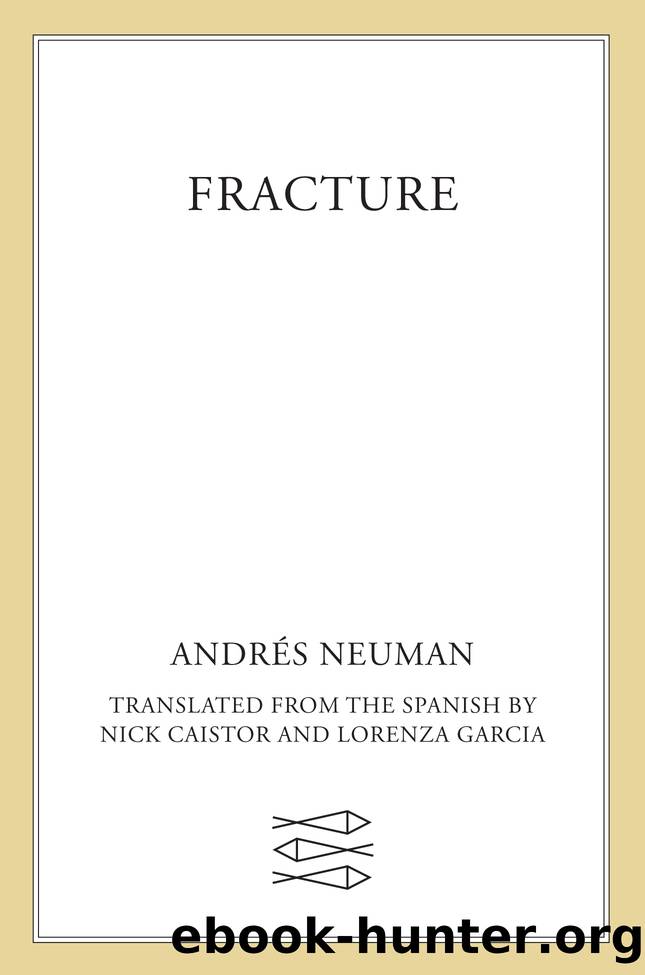
Author:Andrés Neuman
Language: eng
Format: epub, azw3
Publisher: Farrar, Straus and Giroux
* * *
After the commercials, the announcer appears once more on-screen, and staring into the eyes of the viewers, announces the crucial point of todayâs special report: a series of aerial images of the exclusion zone, filmed by drones, shown here for the first time. The shot zooms in on the announcerâs face. His eyebrows seem to take off.
Suddenly, Pripyat appears, the nearest town to the power plant, which since its evacuation has remained in a phantom state. Mr. Watanabe wonders about the hypnotic effect abandoned spaces have on him. What impossible anticipation they provide him with.
Trying to blink, he recalls a trip he once made with Carmen to an abandoned hospital on the Lido, that citadel for consumptives, which became a temple to the strangest kind of hope. Many people with incurable illnesses traveled there in the belief they would be saved, surrounded by palaces and beauty. To him it had seemed like a very moving place. But sheâd found it sinister. Experiencing such contrasting emotions somehow distanced them. Between the two of them, he now realizes, theyâd spanned the arc of a single response: the place contained both extremes. As they walked through the stripped offices, Carmen wanted to take with her one of the typewriters. And he begged her not to touch anything.
Empty places, observes Watanabe, are often filled with contradiction. For example, around Pripyat, nature is crowded and it spreads with vengeful force. Cattle graze along its avenues. Horses gallop in wild droves. Wolves, whose tracks abound, have made their lairs in houses. Eagles snatch impossibly large prey. Black storks outnumber white ones. Some of the soldiers who patrol the area allege sightings of bears that have been extinct for more than a century. And everywhere, the zoom shows, are millions of swarming ants, like a relentless calligraphy rewriting everything.
Why life is so insistent, even in the most hostile of environments, continues to be a mystery that produces in Mr. Watanabe a perplexed gratitude. For the local fauna, Chernobyl has been transformed into a paradise. Paradise, he reflects, would be the absence of human beings.
At the time of the explosion, he hears, the average age of the inhabitants was below thirty. They called it the city of the future.
Pripyat is archaeologically pure. There is no need for excavations: the layers of memory are exposed. The building that strikes him most is the post office. Lying amid the moss and weeds are all the undelivered letters. If someone ran over to read them, he imagines, would time begin again?
Watanabe glances at the time. He doesnât feel tired, but he knows he will be tomorrow if he doesnât go to bed straightaway. Just as his finger is touching the red OFF button, he is shocked by the Pripyat fairground. Childhood and graveyard seem to coincide in its attractions. Most disturbing is the way happiness and wretchedness have lost all distinction. A nuclear celebration.
On the screen gleaming bumper cars jostle their own stillness. The empty carrousel, bewildered as a tree with no branches.
Download
This site does not store any files on its server. We only index and link to content provided by other sites. Please contact the content providers to delete copyright contents if any and email us, we'll remove relevant links or contents immediately.
The Fine Print (Dreamland Billionaires Book 1) by Lauren Asher(2543)
Fury of Magnus by Graham McNeill(2435)
The Last House on Needless Street by Catriona Ward(2379)
The Rose Code by Kate Quinn(2185)
A Little Life: A Novel by Hanya Yanagihara(2087)
Malibu Rising by Taylor Jenkins Reid(1900)
Luster by Raven Leilani(1888)
The God of the Woods by Liz Moore(1885)
Transcendent Kingdom by Yaa Gyasi(1843)
Moonflower Murders by Anthony Horowitz(1830)
The Lost Book of the White (The Eldest Curses) by Cassandra Clare & Wesley Chu(1676)
This Changes Everything by Unknown(1494)
The Midwife Murders by James Patterson & Richard Dilallo(1470)
The New Wilderness by Diane Cook(1431)
The Lying Life of Adults by Elena Ferrante(1422)
Wandering in Strange Lands by Morgan Jerkins(1399)
Written in the Stars by Alexandria Bellefleur(1388)
Ambition and Desire: The Dangerous Life of Josephine Bonaparte by Kate Williams(1377)
The Lying Life of Adults by Elena Ferrante;(1301)
